
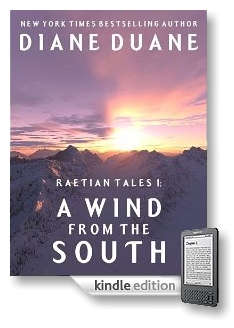
So some of you may remember that a little while ago I moved A Wind from the South from its free-at-website-only status to wider availability at Amazon, this time actually charging money for it… i.e., a shattering USD $1.99. (Having first made sure everyone who might have wanted it free had had their chance.) This was in the nature of an experiment, to see how (or if) low ebook prices worked for me.
So the first paycheck in which AWFTS was included has come in, and it wasn’t bad. But the sales still weren’t exactly stellar. So I took the experiment in a slightly different direction: I raised the price to USD $4.99.*
And suddenly sales have jumped.
Could it be that, when you’re an author who’s been established in print for a while, that it’s not smart to price your book too low? Is it possible that people look at it and say, “Oh, this thing must be cheap because it’s no good”, and pass by on the other side? Or is this just some seasonal effect, or some other kind of coincidence?
It’ll be interesting to see how the next month or two of sales goes. (BTW, for those of you who might want it, the book remains available for a lower-than-Amazon price at the Ebooks Direct shop at DD.com. I’m waiting to see if the dreaded Amazon PriceBot notices the lower price and discounts the Amazon version of the book accordingly.)
*For international purchasers, VAT is added and the price goes up a little. It’s $5.86 when you’re buying it in Ireland, for example.

20 comments
Hm. I’ve had a habit of sorting unknowns out by price sometimes. Too low of a price plus unknown-to-me author plus cover snobbery will give me pause. You can even sort out the too-low-priced stuff without looking at them much. Maybe the combination of being in a higher price bracket and among different book peers plus an above average cover (it doesn’t try to do more than it sets out to do…this is actually very important) gives you a better edge. Maybe having some sales under your belt and a higher ranking has helped moving up too.
Hm. I’ve had a habit of sorting unknowns out by price sometimes. Too low of a price plus unknown-to-me author plus cover snobbery will give me pause. You can even sort out the too-low-priced stuff without looking at them much. Maybe the combination of being in a higher price bracket and among different book peers plus an above average cover (it doesn’t try to do more than it sets out to do…this is actually very important) gives you a better edge. Maybe having some sales under your belt and a higher ranking has helped moving up too.
The problem with readers consumers is the next: They perceived free stories as “Not as good to be charged on”. A misperception but true and existing among consumers. We have the example such as free classics like Charles Dickens, everybody knows Dickens work and is on the silabus of every literature class. But a XXI writer is looked with distrustful and wont believe a new story being cheap or free could be that good. But in new ITEMS such a laundry detergent or a new toothpaste with a “free offer” is different the perception as being from two different markets.
The problem with readers consumers is the next: They perceived free stories as “Not as good to be charged on”. A misperception but true and existing among consumers. We have the example such as free classics like Charles Dickens, everybody knows Dickens work and is on the silabus of every literature class. But a XXI writer is looked with distrustful and wont believe a new story being cheap or free could be that good. But in new ITEMS such a laundry detergent or a new toothpaste with a “free offer” is different the perception as being from two different markets.
The problem with readers consumers is the next: They perceived free stories as “Not as good to be charged on”. A misperception but true and existing among consumers. We have the example such as free classics like Charles Dickens, everybody knows Dickens work and is on the silabus of every literature class. But a XXI writer is looked with distrustful and wont believe a new story being cheap or free could be that good. But in new ITEMS such a laundry detergent or a new toothpaste with a “free offer” is different the perception as being from two different markets.
It happens pretty often in the crafty world, too, that bumping your price up will increase sales. Seems to be a perceived value thing.
Also, yay for higher sales _and_ more money!
It happens pretty often in the crafty world, too, that bumping your price up will increase sales. Seems to be a perceived value thing.
Also, yay for higher sales _and_ more money!
What other factors changed?
What other factors changed?
[…] via Out of Ambit […]
Interesting. I’m trying to figure out how best to manage pricing of my book (“Culinary School: Three Semesters of Life, Learning, and Loss of Blood” http://amzn.to/eOKJWw), too. I’m learning!
Interesting. I’m trying to figure out how best to manage pricing of my book (“Culinary School: Three Semesters of Life, Learning, and Loss of Blood” http://amzn.to/eOKJWw), too. I’m learning!
[…] some time. Amazon isn't ditching print anytime soon. With Ebook Pricing, is Cheap Always Better? An intriguing blog post from author Diane Duane, who has been publishing some of her backlist to Amazon. When Ms. Duane […]
I saw an increase in sales when I increased the price of one of my ebooks from $2.99 to 4.99. I suspect the price break is somewhere around 4.99-6.99, maybe a bit less for reprints, but not 99 cents or 1.99 — those work for short stories and novellas.
I saw an increase in sales when I increased the price of one of my ebooks from $2.99 to 4.99. I suspect the price break is somewhere around 4.99-6.99, maybe a bit less for reprints, but not 99 cents or 1.99 — those work for short stories and novellas.
For me, $1.99 or lower means it’s a short story and I don’t care to pay for short stories. That’s just my personal take on things. Very interesting findings. Thanks for posting.
For me, $1.99 or lower means it’s a short story and I don’t care to pay for short stories. That’s just my personal take on things. Very interesting findings. Thanks for posting.
For me, $1.99 or lower means it’s a short story and I don’t care to pay for short stories. That’s just my personal take on things. Very interesting findings. Thanks for posting.
This is so common that it’s actually taught in marketing classes. There is something in the brain that believes that price = quality.
This is so common that it’s actually taught in marketing classes. There is something in the brain that believes that price = quality.
Comments are closed.